
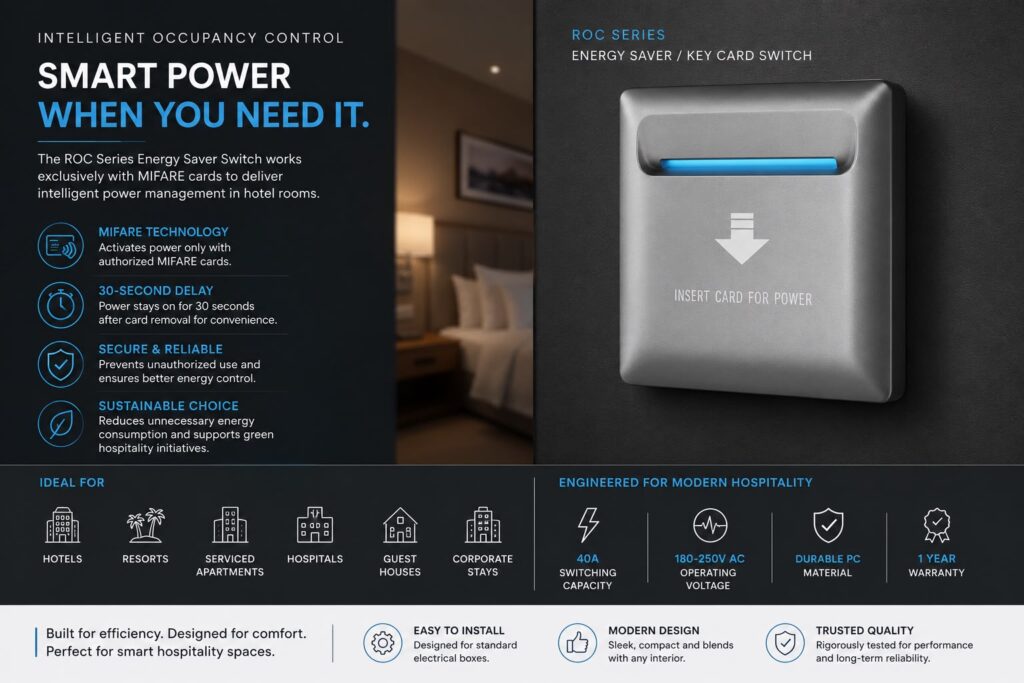
Why MIFARE Technology is the Preferred Choice for Modern Hospitality ?
As the hospitality industry continues to embrace digital transformation, guest room access control and energy management have become increasingly interconnected. Modern hotels demand intelligent systems that not only improve operational efficiency but also enhance security, reduce energy consumption, and deliver a seamless guest experience.
The ROC Series Energy Saver Switch by Giret is engineered to operate exclusively with MIFARE RFID cards, ensuring that electrical power is activated only by an authorized hotel room key card. Unlike conventional card holder switches that can be triggered using virtually any card-shaped object, the ROC Series employs MIFARE technology to support controlled and reliable occupancy-based power management.
This approach enables hotels to maintain better control over guest room electricity usage while minimizing misuse and supporting standardized operational practices.
What is MIFARE Technology?
MIFARE is a globally recognized contactless RFID (Radio Frequency Identification) smart card technology widely adopted in hotels, commercial buildings, universities, healthcare facilities, corporate campuses, and secure access environments.
A MIFARE card contains an embedded integrated circuit (IC) and communicates wirelessly with compatible RFID readers using radio frequency technology. In hospitality applications, these cards are commonly used for:
- Guest room access control
- Energy saver switch activation
- Elevator access authorization
- Staff access management
- Secure area entry
- Cashless payment systems
- Time attendance systems
- Building access control
By using MIFARE-enabled systems, hotels can integrate room access and energy management into a unified operational workflow.
Why Does the ROC Series Accept Only MIFARE Cards?
The ROC Series is intentionally designed to recognize only compatible MIFARE cards, offering several operational advantages over generic card holder switches.
Enhanced Energy Control
Generic card holder switches can often be activated using business cards, loyalty cards, folded paper, or other similarly sized objects. This allows guests to leave room appliances operating even when they are away, reducing the effectiveness of energy-saving initiatives.
The ROC Series helps prevent such misuse by requiring a compatible MIFARE card to activate the power supply.
Improved Operational Discipline
Since the switch responds only to the designated technology, hotels can better ensure that room power is associated with legitimate occupancy, supporting more consistent energy management practices.
Better Compatibility with Modern Hotel Infrastructure
Many contemporary hotels already utilize MIFARE-based RFID door lock systems. Using a compatible Energy Saver Switch creates a cohesive technological ecosystem that simplifies guest operation and facility management.
Typical Variants of Energy Saver Switches
The hospitality market offers several types of Energy Saver Switches, each designed for different operational requirements.
Any Card Energy Saver Switch
Activates when almost any card of suitable size is inserted. While economical, it is more susceptible to misuse and is generally suited to applications where strict energy control is not essential.
MIFARE Card Energy Saver Switch
Designed specifically for MIFARE RFID cards. The ROC Series falls into this category and is intended for hotels that require reliable occupancy-based power management.
RFID Smart Card Energy Saver Switch
Supports advanced RFID-enabled cards and is commonly integrated into modern hotel automation systems.
IC Card Energy Saver Switch
Compatible with integrated circuit smart cards used in certain access control systems.
Magnetic Stripe Card Energy Saver Switch
Designed for legacy magnetic key card systems, now less common as RFID technologies have become the preferred standard.
Safety Features of the ROC Series
Electrical safety and operational reliability are fundamental requirements in hospitality environments where equipment operates continuously and guest safety is paramount.
The ROC Series incorporates features that support dependable performance, including:
- Controlled activation through MIFARE card recognition
- Automatic power disconnection after approximately 30 seconds of card removal
- Robust 40A switching capacity for designated electrical loads
- Polycarbonate housing providing durable electrical insulation
- Operation within a standard voltage range of 180–250V AC
Proper installation by qualified electrical professionals and adherence to applicable electrical standards are essential to ensure safe and reliable operation.
Integration with Hotel RFID Door Lock Systems
In many hospitality projects, the Energy Saver Switch functions alongside RFID door lock systems to create a streamlined guest experience.
A typical sequence is as follows:
- The guest unlocks the room using the assigned MIFARE key card.
- Upon entry, the same card is inserted into the ROC Energy Saver Switch.
- The switch activates the configured room circuits.
- The guest enjoys normal use of lighting and selected electrical amenities.
- When leaving, the guest removes the card.
- After the programmed delay, the switch disconnects non-essential power.
This unified workflow enhances convenience while reinforcing responsible energy usage.
Integration with Guest Room Management Systems (GRMS)
Guest Room Management Systems (GRMS) are increasingly adopted in premium hotels to automate room functions and improve operational efficiency.
An Energy Saver Switch can complement GRMS by serving as an occupancy indicator, enabling coordinated control of systems such as:
- Lighting
- Air conditioning
- HVAC
- Selected power outlets
- Occupancy-based automation
The exact level of integration depends on the hotel’s overall electrical and automation design.
Building Management System (BMS) Compatibility
Building Management Systems (BMS) enable centralized monitoring and management of building services, including energy consumption.
Within a broader hotel infrastructure, occupancy-based power control provided by an Energy Saver Switch contributes to overall energy management objectives by reducing unnecessary electrical loads in unoccupied rooms.
When combined with BMS strategies, ESS deployment can support improved operational efficiency and sustainability initiatives.
Engineering Considerations for Hospitality Projects
Selecting the appropriate Energy Saver Switch requires careful evaluation of project-specific requirements.
Key considerations include:
- Compatibility with the hotel’s access control technology
- Electrical load requirements
- Switching capacity
- Operating voltage
- Installation environment
- Guest room electrical design
- Integration with automation systems
- Durability of construction materials
- Ease of maintenance
- Long-term operational reliability
The ROC Series addresses these considerations through its MIFARE compatibility, 40A switching capacity, and robust polycarbonate construction.
Advantages for Hotel Owners and Facility Managers
For hotel owners, engineering teams, and facility managers, an Energy Saver Switch represents an investment in operational efficiency rather than merely an electrical accessory.
Key advantages include:
- Improved control over room electricity usage
- Reduced avoidable energy consumption
- Support for sustainability initiatives
- Enhanced consistency in guest room operations
- Reliable integration with MIFARE-based access systems
- Professional appearance suited to modern interiors
- Simplified occupancy-based power management
Use Cases Across Hospitality Segments
The ROC Series Energy Saver Switch is suitable for a broad range of hospitality and commercial accommodation environments, including:
- Luxury Hotels
- Boutique Hotels
- Business Hotels
- Resorts
- Serviced Apartments
- Corporate Guest Houses
- Premium Hostels
- Holiday Homes
- Hospitals
- Wellness Centres
- Senior Living Communities
- Institutional Accommodation
- Executive Residences
Its design supports projects where energy efficiency, operational reliability, and guest convenience are important considerations.
Supporting Sustainable Hospitality
Sustainability has become a central objective for the global hospitality industry. Intelligent technologies such as Energy Saver Switches contribute to this objective by helping reduce unnecessary electricity consumption in unoccupied rooms.
While actual energy savings depend on building design, guest behavior, and operational practices, occupancy-based power management is widely recognized as a practical component of broader energy conservation strategies.
Hotels implementing such systems may also strengthen their environmental initiatives and support responsible resource management.
Why Choose the Giret ROC Series?
The ROC Series Key Card Holder combines intelligent MIFARE card recognition, dependable electrical switching, durable polycarbonate construction, and a practical 30-second delay function in a compact solution tailored for hospitality applications.
Key product highlights include:
- MIFARE card compatibility
- 40A switching capacity
- Operating voltage: 180–250V AC
- Automatic 30-second power-off delay
- Durable PC housing
- Compact dimensions: 120 × 70 × 38 mm
- Designed for modern hotel electrical systems
- One-year warranty
- Suitable for hospitality projects across India
Modern hospitality increasingly relies on intelligent technologies that balance guest comfort with operational efficiency. By utilizing MIFARE-based authentication, dependable switching performance, and occupancy-based power management, the Giret ROC Series Energy Saver Switch provides hotels with a practical solution for managing guest room electricity responsibly. Its compatibility with contemporary hospitality infrastructure, combined with robust construction and thoughtful engineering, makes it well suited for new hotel developments as well as renovation projects.
About Giret International
Socials : Instagram | Facebook | Youtube | Pinterest | Thread | X