
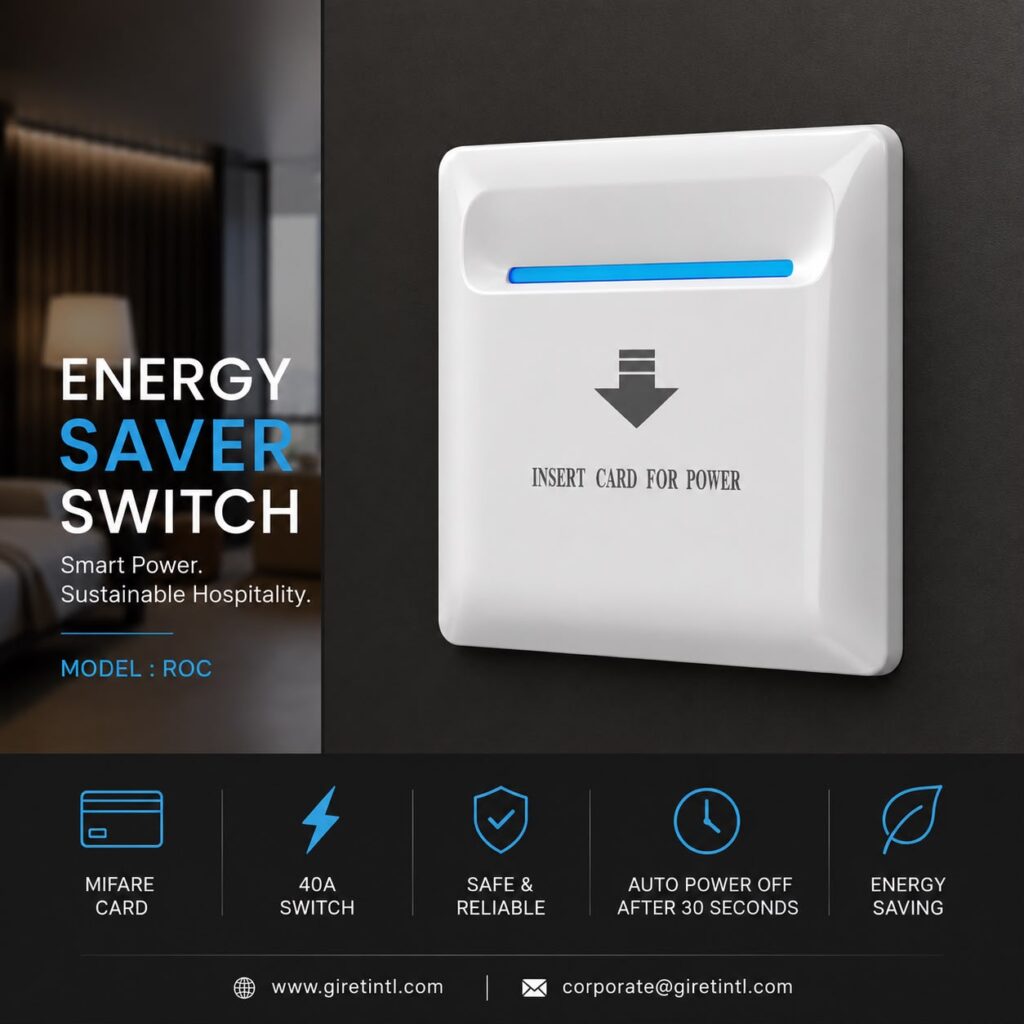
Understanding the Engineering Behind a Hotel Energy Saver Switch
The modern hospitality industry increasingly depends on intelligent technologies that improve operational efficiency, reduce energy consumption, enhance guest comfort, and support sustainability initiatives. Among these technologies, the Hotel Energy Saver Switch (ESS) has become one of the most essential electrical control devices installed in guest rooms.
While the Energy Saver Switch appears externally as a simple wall-mounted card holder, its internal operation is the result of carefully engineered electrical switching, occupancy-based control logic, relay technology, and secure card authentication. Every insertion or removal of an authorized room card initiates a sequence of electrical actions designed to ensure that power is supplied only when the room is occupied, thereby minimizing unnecessary electricity consumption.
The Giret ROC Series Energy Saver Switch has been developed specifically for hospitality applications, combining intelligent MIFARE card recognition with dependable electrical switching. It provides controlled power distribution while helping hotels reduce operational costs and improve energy efficiency.
Working Principle of the ROC Series Energy Saver Switch
The ROC Series operates on an occupancy-based power management principle. Unlike conventional switches that depend entirely on manual operation, this system activates or deactivates selected electrical circuits according to the presence of an authorized MIFARE key card.
The operating sequence is straightforward:
- The guest unlocks the room using the assigned MIFARE key card.
- Upon entering, the guest inserts the same MIFARE card into the ROC Energy Saver Switch.
- The switch authenticates the presence of a compatible MIFARE card.
- Once validated, the internal relay energizes, allowing electrical power to flow to designated room circuits.
- Lighting, selected power sockets, and other configured electrical loads become operational.
- When leaving, the guest removes the card.
- The switch maintains power for approximately 30 seconds, allowing sufficient time to exit comfortably.
- After the delay, the relay disconnects non-essential electrical circuits automatically.
This sequence ensures that electricity is consumed only during occupancy while maintaining a seamless guest experience.
Why the ROC Series Uses MIFARE Technology
Unlike generic card holder switches that activate with almost any card-shaped object, the ROC Series is designed to work exclusively with MIFARE cards. This provides a higher level of control and security.
Key advantages include:
- Prevents activation using business cards, membership cards, or paper inserts.
- Ensures power is available only with the hotel’s authorized room card.
- Reduces intentional misuse of the system.
- Supports disciplined energy management across the property.
- Enhances integration with RFID-based hotel access systems.
By relying on authenticated MIFARE technology, the ROC Series aligns with modern hospitality standards where access control and energy management operate together.
Internal Electrical Architecture
Although compact in appearance, the Hotel Energy Saver Switch contains multiple engineered components working in coordination.
Its internal architecture typically consists of:
- MIFARE card sensing module
- Electronic control circuit
- High-capacity 40A relay
- Time-delay controller
- Input power terminals
- Output load terminals
- Protective housing
- Status indicator (where applicable)
Each component performs a distinct function, ensuring reliable operation throughout repeated guest occupancy cycles.
The Role of the 40A Relay
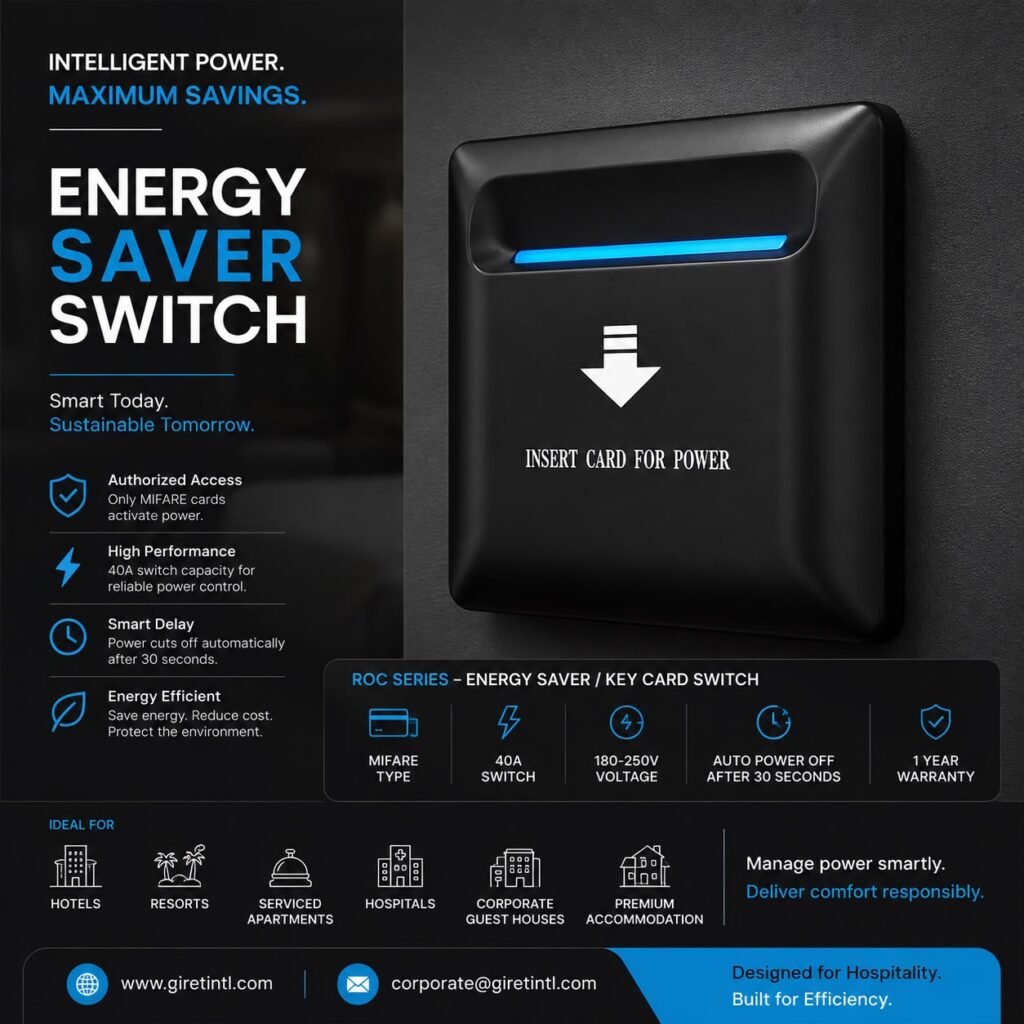
The relay serves as the primary switching element within the Hotel Energy Saver Switch. In the ROC Series, the use of a 40A switching capacity enables reliable control of designated electrical loads commonly found in hotel guest rooms.
When an authorized MIFARE card is inserted, the relay closes the circuit, allowing electrical power to reach configured room systems. After the programmed delay following card removal, the relay opens the circuit, disconnecting non-essential loads.
The robust relay design contributes to:
- Stable switching performance
- Reliable electrical isolation
- Reduced wear during repeated operation
- Suitability for demanding hospitality environments
Operating Voltage
The ROC Series is designed for an operating voltage range of 180–250V AC, making it suitable for standard electrical installations commonly used in hotels, resorts, serviced apartments, and commercial accommodation projects.
This operating range supports consistent performance under normal utility supply conditions while integrating with standard guest room electrical infrastructure.
Intelligent 30-Second Delay Function
One of the defining features of the ROC Series is its automatic 30-second power-off delay.
Rather than disconnecting power immediately when the card is removed, the system intentionally maintains electrical supply for approximately thirty seconds.
This engineered delay provides several practical advantages:
- Allows guests to exit safely without entering darkness immediately.
- Gives sufficient time to collect personal belongings.
- Improves guest convenience during departure.
- Prevents abrupt interruption of room lighting at the doorway.
- Enhances the overall user experience.
After the delay expires, the switch automatically disconnects configured non-essential electrical circuits, preventing unnecessary energy consumption.
Polycarbonate (PC) Construction
The external body of the ROC Series is manufactured from Polycarbonate (PC), a material widely recognized for its strength and suitability in electrical products.
Key characteristics include:
- High mechanical durability
- Dimensional stability
- Resistance to everyday impacts
- Good electrical insulation properties
- Suitable for commercial hospitality installations
- Clean, professional appearance that complements contemporary interiors
Its compact dimensions of 120 × 70 × 38 mm also facilitate integration into modern guest room designs.
Typical Loads Controlled by an ESS
An Energy Saver Switch is generally configured to control non-essential guest room electrical loads, depending on the hotel’s electrical design.
Examples include:
- Main room lighting
- Decorative lighting
- Reading lamps
- Selected switched socket outlets
- Television supply
- Desk lighting
- Ceiling fans (where applicable)
Essential systems-such as emergency lighting, fire alarm interfaces, communication equipment, or other critical services-are typically wired independently to remain continuously operational.
Hospitality Engineering Considerations
During the design of a hotel electrical system, engineers determine which circuits should remain permanently energized and which should be routed through the Hotel Energy Saver Switch. This ensures that guest convenience, operational safety, and energy efficiency are all balanced effectively.
The ROC Series supports this approach by providing a dependable switching solution that integrates easily into guest room electrical layouts while supporting modern hospitality energy management strategies.
Benefits of Occupancy-Based Power Control
By activating room power only when an authorized MIFARE card is present, the ROC Series offers several operational advantages:
- Reduced unnecessary electricity consumption.
- Lower operating costs for hotels.
- Improved energy efficiency.
- Enhanced sustainability initiatives.
- Better control over guest room electrical usage.
- Simplified room power management.
- Support for environmentally responsible hospitality practices.
About Giret International
Socials : Instagram | Facebook | Pinterest | Youtube | Thread | X